
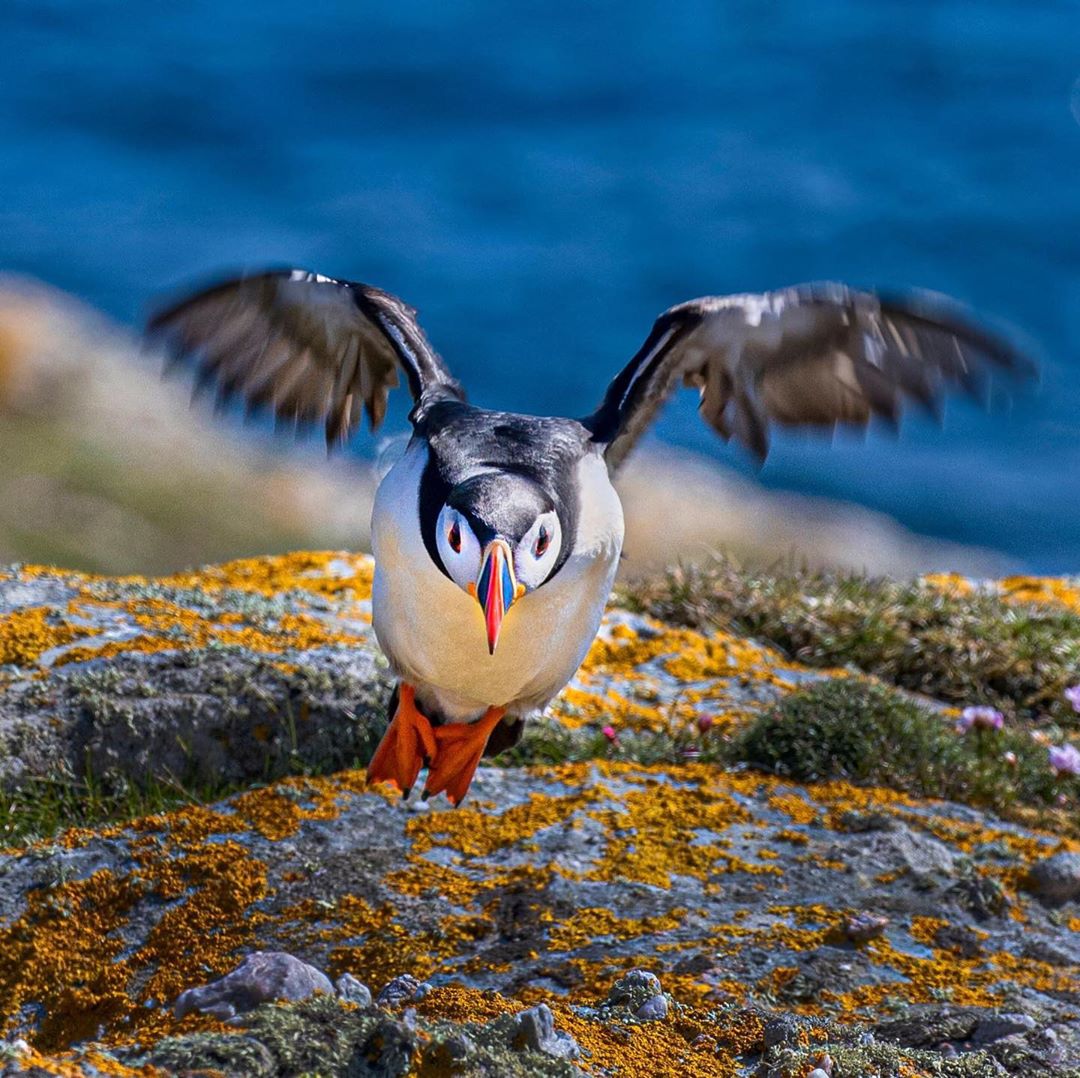
#BehindTheShot with #CanonExplorerOfLight @ricksammonphotography “In action wildlife photography, the key to getting a good shot is to get the head and eye in sharp focus. If the other parts of the body, such as the wings of a bird, are blurred, that’s okay – because that motion-blur adds a sense of movement to a still image.
To get this shot of a puffin in the Faroe Islands flying directly toward me (my goal), I noted the direction in which the birds were taking off. I moved into position, laid down on my belly, and aimed my EOS R with my Canon 100-400mm lens toward a group of puffins that were landing and taking off. I began shooting – extra wide, with lots of space around a puffin so that the wings and feet would not be cut off in my final image. My camera was set to the highest frame rate (5 fps in the AI Servo mode) to capture subtle differences in the animal’s movement. I set the focus to AI Servo (focus tracking, which tracks a moving subject right up to the moment of exposure).
Although I was photographing fast-paced action, I was shooting in the Av (aperture priority) mode, as I always do, adjusting the aperture to get a shutter speed of 1/1000th of a second, which I found is fast enough to ‘freeze’ most birds in flight (except for the wings of some super-fast moving birds). After taking a few shots, and zooming in on them on my camera’s LCD monitor, I knew I had achieved my goal and had at least one ‘keeper.’
The moral of this story: Set a goal, learn about animal behavior, and use AI Servo focus/High Frame Rate when photographing super-fast moving subjects.”
Camera: #Canon EOS R
Lens: EF 100-400mm f/4.5-5.6L IS II USM
Aperture: f/19
ISO: 400
Shutter Speed: 1/1000 sec
Focal Length: 255mm
Ciao, Nihon.