
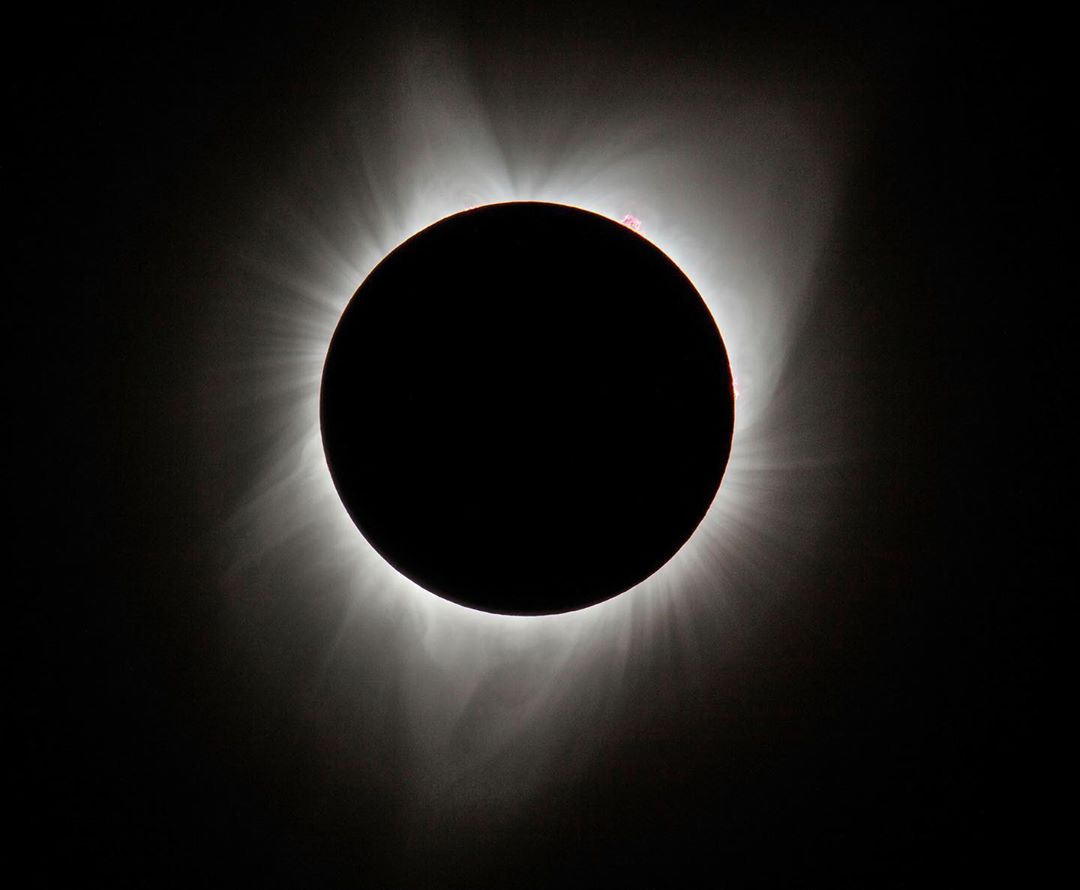
Photo by #CanonExplorerOfLight @davidhumekennerly | “I’ve photographed a lot of extraordinary things in my career, but the total eclipse of the sun on August 21, 2017 is definitely in my top five! The trick was to be in the middle of the path of totality, and out of the way of the clouds. I chose Monmouth, Oregon in the Willamette Valley to take the shot, and it paid off.
During a total solar eclipse, the moon passes between earth and the sun, blocking out the sun’s light. At that moment the white corona, which is the outer layer of the sun’s atmosphere, can clearly be seen surrounding the eclipsed sun. It was a spectacular sight. A bonus was to also document a solar prominence on the top and right side of the sun. A prominence is a bright, fiery, gaseous event that emanates from the sun’s surface, often in the shape of a loop. A typical prominence can extend more than 62,000 miles from the sun’s surface, and is ten times the size of earth. Some reach more than 300,000 miles into space.
To accomplish this photograph I used a Canon 5DS R with a Canon 800mm f/5.6 lens coupled with a 1.4 Extender II, making it 1120mm. The ISO was 320, the exposure 1/320 at f/8. It would not have been possible to see the prominence without this long lens.
If I’m lucky enough to witness another solar eclipse, I will choose the Canon 1200mm with the 1.4 extender. That will give me a 1680mm look at another amazing celestial event! My intention is to photograph the April 8, 2024 eclipse from Burlington, Vermont.” Photo Credit: David Hume Kennerly/ Center for Creative Photography/University of Arizona
Camera: #Canon EOS 5DS R
Lens: EF 800mm f/5.6L IS USM/Extender EF 1.4x II
Aperture: f/8
ISO: 320
Shutter Speed: 1/320 sec
Focal Length: 1120mm
Ciao, Nihon.