
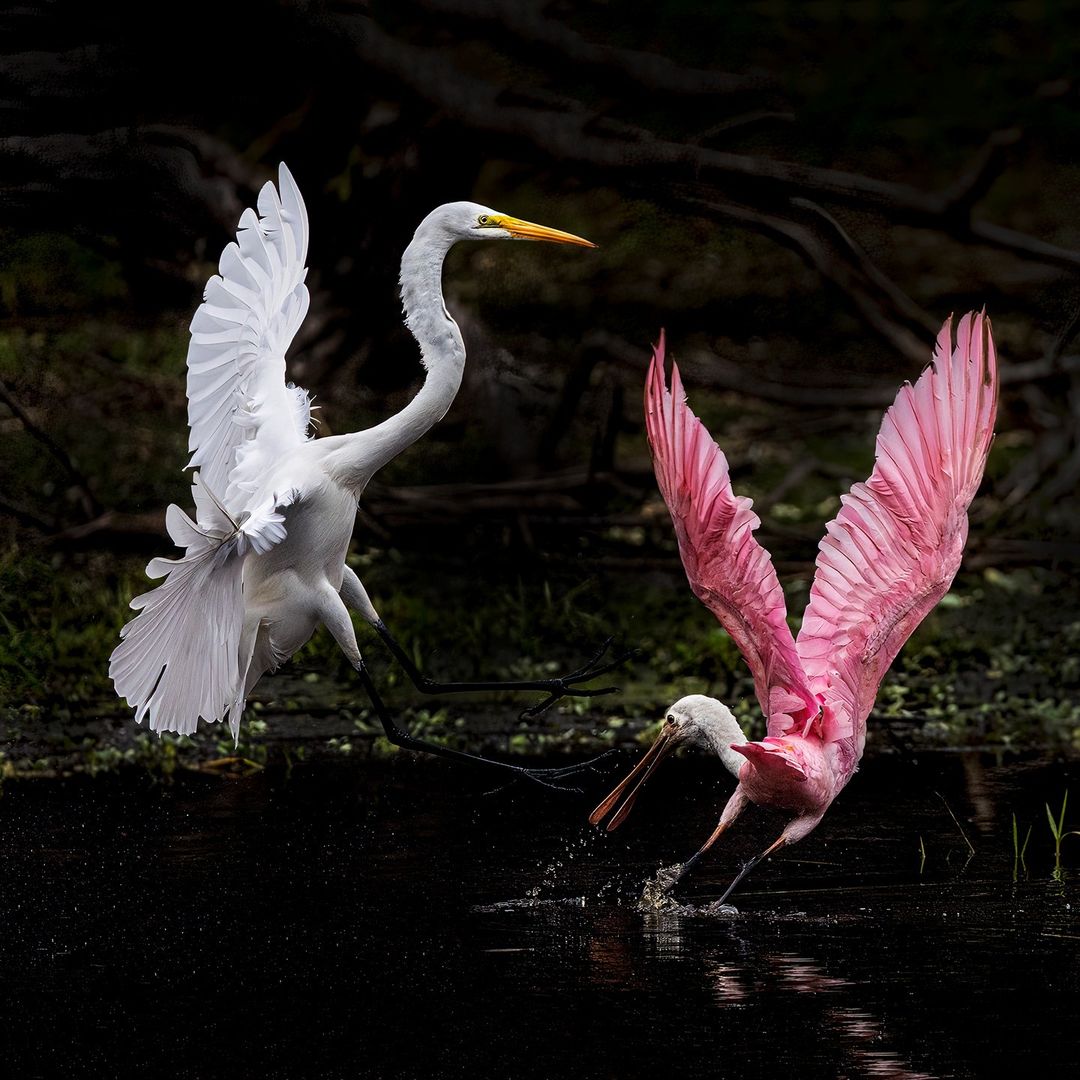
Photo by #CanonExplorerOfLight @ricksammonphotography: “What’s harder than getting a sharp BIF (Birds in Flight) photograph? Getting a photograph with two birds in flight!
While we were driving through Myakka River State Park in Sarasota, Florida early one morning, we came upon a shaded pond filled with more than a dozen birds, including Great Egrets and Roseate Spoonbills – two of the most sought-after subjects for bird photographers, pros and enthusiasts alike.
It was very overcast and the light level was very low, so to get a sharp shot of the fast moving birds, I boosted my ISO to 3200, which gave me a shutter speed of 1/4000th of a second – more than fast enough to ‘freeze’ the action.
As I knew the birds would be darting around the pond, I chose the following Auto Focus settings on my Canon EOS R3: Subject to Detect – Animals, Eye Detection – Enabled and AF Operation – Servo.
To capture subtle differences in gesture, which is the key to a good wildlife photograph, I set the Drive Mode to High Speed Continuous+.
And speaking of darting around, I used my Canon RF100-500mm F4.5-7.1 L IS USM lens so I could quickly and easily vary my composition. And I was not tied down with a tripod.
Because the subjects were much lighter than the background, I set my exposure compensation to EV-1, which preserved the detail in the feathers of these magnificent birds.
This photograph illustrates four important bird photography pointers: One, if the eyes are not in focus and well lit, you’ve missed the shot. Two, it’s wings up or wings down for an image with impact. Three, never underestimate the importance of a good subject. Four, luck favors the prepared photographer.”
📸 #Canon EOS R3
Lens: RF100-500mm F4.5-7.1 L IS USM
Ciao, Nihon.